


‘Defiant’ Pair Iovine & Young and Other Unlikely Duos That Changed the World
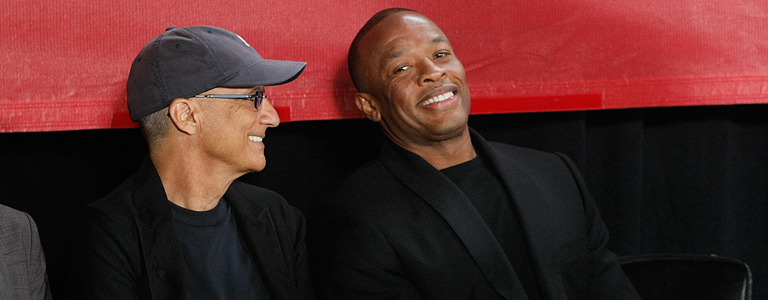
At first glance Andre Young and Jimmy Iovine look like unlikely partners. As Dr. Dre, in the 1980s and 1990s Young wrote and performed anguished gangsta rap about his home town of Compton, police brutality and gangs.
Jimmy Iovine, the son of an Italian-American longshoreman from Brooklyn, started out sweeping floors in a New York City recording studio before working his way up to sound engineer, producer and record executive, working with rock idols like Bruce Springsteen, U2 and Stevie Nicks.
But looks, as they say, can deceive. Beneath their differences—East Coast, West Coast, gangsta rap vs. polished rock—Iovine and Young shared a lot. Both were geniuses in the recording studio, determined to get the music just right. Both pushed their artists—and themselves—to break convention and try new sounds. And both were gluttons for hard work, with a deep passion for the music business. Over the years, they formed a working relationship and then a partnership that resulted in the innovative headphone company Beats Electronics, which was acquired in 2014 by Apple for $3.2 billion in cash and stock.
If your ultimate strengths as a pair are going to be based on your differences, you’re not going to appreciate those differences right away.
The complete story of their odd-couple partnership is being told in a four-part docuseries “The Defiant Ones” now showing on HBO. The title nods to the 1958 crime film starring Sydney Poitier and Tony Curtis about two escaped prisoners, one black and one white, who were shackled together and had to cooperate to survive.
“Just like you need to have complementary strengths and weaknesses, you need to have some things happen at the mission level,” says Steve Barth, assistant professor of entrepreneurship at USC Jimmy Iovine and Andre Young Academy for Arts, Technology and the Business of Innovation. (The academy was established in 2013 with a multimillion dollar gift from Iovine and Young following the sale of Beats.) “You’ve got to share something about that mission to have it work as a partnership.”
Despite Iovine’s and Young’s different backgrounds, Barth said, “one thing that comes through very clearly is that they both have this really strong commitment to quality and that when they were engineering or producing, this total dedication to achieve a level of quality was kind of unprecedented in the work that they were doing.
”While the best partners do need to start with a common goal, many move forward by testing ideas against each other, rejecting the bad, and building off the good.
That doesn’t mean all members of a partnership should think exactly alike. While the best partners do need to start with a common goal, many move forward by testing ideas against each other, rejecting the bad, and building off the good. Book publisher Joel Fotinos points out that Abraham Lincoln understood the relationship between diverse thinking and success. In 1860, Lincoln appointed his three major political adversaries to his presidential cabinet — the famed “team of rivals.”
Historian Doris Kearns Goodwin, who wrote a book about Lincoln’s wartime cabinet, told National Public Radio that Lincoln possessed the emotional intelligence to keep the disparate members of the group together. The partnership was necessary to lead a nation that was divided– literally – by the Civil War.
“As long as he could keep that coalition together, he was keeping those strands in the country together as well,” she said.
Superstar investors Warren Buffett and Charlie Munger are another example of a strong, durable and hugely successful partnership between fiercely independent thinkers. Early on, the two famously did not share investing philosophies. It took 25 years of exchanging phone calls and letters, then investing in some of the same deals, before they formalized their partnership in Buffett’s Berkshire Hathaway.
“When you find somebody to partner with, it may be less about love at first sight than about a lot of persistent work in the beginning to make the partnership work,” says USC’s Barth. “If your ultimate strengths as a pair are going to be based on your differences, you’re not going to appreciate those differences right away.
As author Joshua Wolf Shenck writes in his book “Powers of Two,” “The problem is when members of a group look at situations the same way, and fail to appreciate difficulties coming down the pike. Loyalty and devotion can outstrip independent thinking.”
Shenk points to the founders of Apple as partners whose similarities “approach the level of twin peaks” and whose differences “feel as gaping as the Grand Canyon.”
Picture two undergrads named Steve as they were in 1972, knocking on dorm rooms at UC-Berkeley.
“Hi, is George here?” one would ask. They claimed they were looking for a guy named George who loved making free phone calls.
It was somewhere between a prank and a door-to-door salesmen’s hook. They had a blue box that could mimic the phone company’s digital dial tones, allowing a user to place free long-distance calls.
One Steve — Wozniak — would have been happy to share the gadget with his friends and move on to some other geeky tech project.
The other Steve — Jobs — didn’t have the technical ability to build the device. What he did have was a genius-level ability to recognize and even anticipate the products that people wanted.
In other words, it took both Steves to make and then sell the blue box. One Steve without the other and the world would never have had the Macintosh or the iPhone, much less Apple, the world’s second-most valuable company.
One final thing about good partners: They don’t rest on their laurels. They can rely on each other to keep moving forward, building on their successes without being blinded by them. Iovine and Young fit that model, Allen Hughes, director of “The Defiant Ones” told Vanity Fair. One of the challenges to telling their story was getting Iovine and Young to talk about the past and their many successes. “They literally don’t look back at anything they’ve accomplished,” Hughes said. “They don’t talk about it. … They just keep moving. They don’t have a rearview mirror.”
Citation: USC Iovine and Young Academy’s online Master of Science in Integrated Design, Business and Technology